The twin models use 2.7-inch vertical slat spacing β narrow enough to block arms and legs, wide enough to eliminate pinch hazards.
On a standard 4β6 inch toddler mattress, that leaves roughly 13β15 inches of rail above the sleep surface β meaningfully taller than most competitors at this price point.
The integrated LED lighting and dual-sided reversible book ledge come standard on the twin models β no separate purchase, no compatibility questions.
The full-size daybed holds 350 lbs, supports three rail configurations, and runs on solid pine construction β built for co-sleeping families and long-term use.
Two distinct products, three configurations: the High-Rail Twin serves toddlers transitioning from a crib with maximum enclosure and built-in features, while the Full Convertible Daybed grows with a child from co-sleeping through early elementary with a detachable rail system and a 350 lb frame. Both are designed around the same core principle β get the child low enough that the floor is a soft landing, and give them a way in and out they can manage on their own.
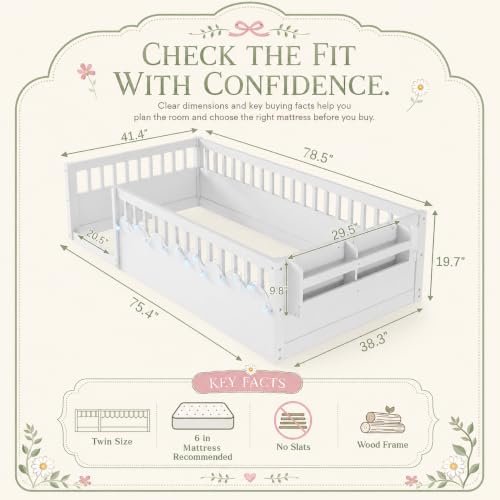
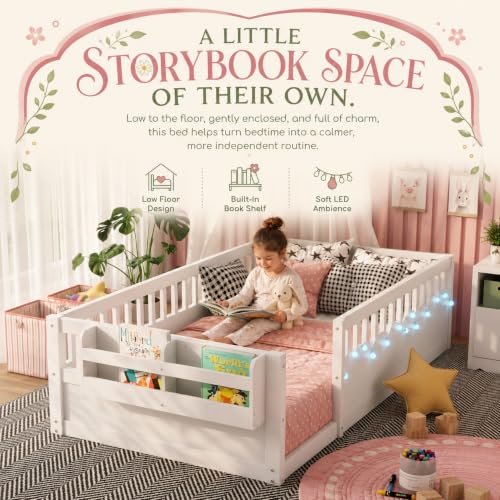
The flagship Duxelifin model: a twin floor bed with 19.7-inch perimeter rails, 2.7-inch slat gaps, and 7.8 inches of floor clearance. An LED strip wraps the frame perimeter for 2am navigation, and the reversible book ledge mounts left or right depending on room layout. Pine and MDF construction; 6-inch mattress recommended; all hardware and tools included.
The only model in the lineup that combines full enclosure, integrated LED lighting, and built-in book storage β the strongest option for toddlers ages 1β4 coming out of a crib.
See on Amazon
Identical specs to the White twin β same 19.7-inch rails, 2.7-inch slat gaps, LED strip, reversible shelf, and pine-MDF construction β in a grey finish that suits cooler-palette rooms. Six reviews at 3.5 stars versus the White's 109 reviews at 4.0: same product, less purchase history to draw from.
Choose this over the White if your room palette runs grey or neutral β just know you're buying a newer listing with fewer reviews to validate the experience.
See on Amazon
A full-size floor bed built for longer-term use: 5.5-inch floor-to-frame height (the lowest in the lineup), 350 lb weight capacity, and 2.8-inch fence gaps on 3-sided guardrails. The right-side rail detaches, giving you a fully enclosed toddler bed, a wall-hugging daybed with one rail removed, or an open platform β all from the same solid pine frame.
The right call for co-sleeping families or parents who want one bed that converts from enclosed toddler sleep space to open kids' platform without buying a second frame.
See on AmazonA classic Montessori floor bed is exactly what it sounds like: a mattress sitting at or just above floor level, with no surrounding structure, giving a child complete freedom to get in and out whenever they choose. Duxelifin's high-rail twin models aren't that β and it's worth being clear about the difference before you buy.
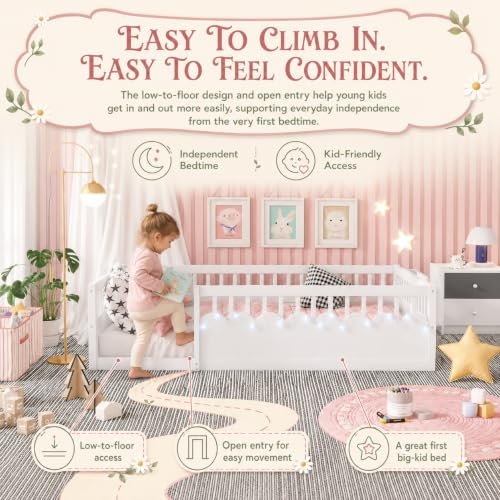
The High-Rail Twin sits 7.8 inches off the ground with a 19.7-inch fence system surrounding the mattress on all sides. That enclosure is what makes it safe for a toddler who still rolls in their sleep. But it also means the bed is closer to a protected crib-alternative than a traditional Montessori floor bed. The wide entry portal is how a child gets in and out independently β that's the Montessori-inspired part.
The Montessori philosophy around sleep has one core idea: a child who can get themselves in and out of bed without adult help develops a sense of physical competence and self-direction. Low-to-the-ground design is the tool for achieving that. At 7.8 inches of floor clearance, a toddler who rolls out during sleep falls a matter of inches. That's the design principle at work β not a certification, not a school affiliation, just a specific measurement that changes what happens when a kid tumbles at 3am.
The "inspired" qualifier matters. No commercial bed frame brand currently holds formal Montessori certification β there's no governing body that certifies furniture. So when any brand uses the term "Montessori bed," they're describing a design approach, not a verified standard. Duxelifin's enclosed twin models are Montessori-inspired in the way that genuinely counts: the child can exit the bed on their own when they're ready, rather than calling for a parent to lift them out.
There's a thread in r/floorbed that makes the rounds β the argument being that beds with surrounding gates are "arguably more unsafe" than a true floor bed because of corners and structural elements a child could bump into. It's worth engaging with honestly rather than dismissing.
A true floor bed eliminates corners at the sleep surface level because there's nothing there. A high-rail bed introduces a fence perimeter that a rolling toddler could theoretically contact. What changes the calculus is how that fence is engineered. Rounded corner joints, inset legs that don't protrude beyond the frame edge, 2.7-inch slat spacing that prevents limb entrapment without creating pinch hazards β these are specific design decisions that address the exact concern the Reddit thread raises. The answer isn't "this concern is wrong." It's "here's what the measurements actually are, and here's what they're designed to prevent."
If you want the closest thing to a traditional Montessori floor bed in Duxelifin's lineup, it's the Full Convertible Daybed (Natural) with both side rails detached. At 5.5 inches of floor-to-frame height with no enclosure rails, the mattress sits essentially at ground level and the child has open access on all sides. That's the configuration for families already familiar with floor beds and moving to a full-size frame as the child grows.
The enclosed high-rail twin is the right choice for families in the crib-to-bed transition who aren't yet ready to let a 20-month-old roam a dark room at 2am. That's a different β and equally valid β set of priorities. Both are Montessori-inspired in design. Neither is Montessori in any certified sense, and neither should claim to be.
Three products, two distinct use cases. The decision usually comes down to four questions: How old is your child right now? Do you co-sleep, or want the option to? How much room enclosure do you need? And do you want the bed to grow with the child for years, or just get through the toddler stage safely?
This is the primary use case for the High-Rail Twin Floor Bed β either the White (B0FHBDPRP7, 109 reviews, 4.0 stars) or the Grey (B0FHB97C8Z, functionally identical). The 19.7-inch perimeter fence system is specifically designed for this moment: the child is mobile, possibly a roller, definitely not ready to navigate a bedroom unsupervised at night, but also hitting the developmental window where crib confinement starts working against their independence. The 7.8-inch floor clearance means a rollout is a minor event, not a fall. The LED strip means they can find the entry portal in the dark without waking the house.
Go White if your room palette runs warm or neutral. Go Grey if you want something that reads cooler. The specs are identical β the only meaningful difference is that the White has 109 reviews to calibrate against, while the Grey has 6. If you're someone who reads reviews before deciding, that gap matters.
The Full Convertible Daybed (B0DZ6C7PNJ, 79 reviews, 4.1 stars) is built for this. The 350-pound weight capacity means a parent lying down isn't a structural concern. The full-size footprint β 56.7 inches wide β gives two people enough room. And the ultra-low 5.5-inch floor height means that when the child eventually transitions out, getting in and out is completely self-managed.
The three-sided guardrail system with detachable right rail is how this one handles co-sleeping logistics: push the no-rail side against the wall and the bed reads as a contained space. Pull it away from the wall with all rails removed and it's an open platform. The headboard and footboard stay fixed regardless of rail configuration β that's the structural constant the child can orient around.
Again, the Full Convertible Daybed. The twin high-rail models are genuinely excellent for the toddler stage β but "toddler stage" is the design brief. A 6-year-old in a fully enclosed twin fence system is a different situation than a 2-year-old. The Full Convertible solves this by letting you remove the rails progressively as the child gains independence, keeping the headboard and footboard as permanent orientation markers. The full-size mattress footprint also means the bed doesn't get replaced when the child grows; it just gets configured differently.
The Full Convertible Daybed again, specifically because of the daybed configuration. With the right rail detached and the non-rail side against the wall, it reads as a daybed rather than a toddler sleep enclosure. The neutral natural pine finish sits comfortably in a room that's pulling multiple duties. The 5.5-inch floor height is low enough that a child can use it independently; the 350-pound capacity means an adult can sit on it without a second thought.
Neither twin model is as well-suited here β the high fence rails are visually specific to the toddler context and don't translate as cleanly to a multi-use room aesthetic.
Specs like "2.7-inch slat gap" and "7.8-inch floor clearance" appear on product listings without much explanation of what they actually mean for a child's safety. Here's what each measurement is actually doing β and where the limits of any bed frame's safety profile begin.
This is the distance between the bottom of the mattress support platform and the floor. At 7.8 inches, a child who rolls out of the High-Rail Twin during sleep falls roughly that distance β less than the height of a standard stair riser. The American Academy of Pediatrics notes that most toddler fall injuries from beds involve heights above 18 inches. At 7.8 inches, the risk profile is meaningfully different from a standard raised bed frame, which typically sits 12β18 inches off the ground.
The Full Convertible Daybed's 5.5-inch floor height takes this further. At that height, a mattress sitting on the frame is essentially at floor level β the difference between rolling off and stepping off becomes negligible for most toddlers.
The Consumer Product Safety Commission's bunk bed safety standard (16 CFR Part 1213) specifies that gaps in guardrail structures must be either narrow enough to prevent a child's head from passing through (under 3.5 inches) or wide enough that entrapment isn't possible (over 9 inches). The 2.7-inch gap on the twin models sits under that 3.5-inch threshold β sized to keep a small arm or leg from passing through far enough to create an entrapment risk, while narrow enough that the slat itself doesn't create a pinch hazard.
The 2.8-inch gap on the Full Convertible is 0.1 inches wider β still well within the safe range, and designed slightly wider likely because the full-size frame uses longer rail spans where a marginally wider gap reduces visible flex in the rail panel.
This is the total height from the floor to the top of the fence rail β not from the mattress surface. Actual containment height above the sleep surface depends on mattress thickness. With a 6-inch mattress (Duxelifin's recommended thickness for the twin), rail height above the mattress is approximately 13.7 inches. With a thicker 8-inch mattress, that drops to about 11.7 inches. Both figures are meaningful containment for most toddlers under 3; active climbers approaching 4 will have more leverage against that height.
The product listing notes the rails accommodate mattresses up to 12 inches thick β at that thickness, the rail above the mattress surface is only 7.7 inches, which provides minimal containment for an older or taller child. Stick with the recommended 6-inch mattress if containment is the primary goal.
These are structural design choices rather than certifications. The corner joints on Duxelifin frames are finished to a radius β meaning the edge is curved rather than square β which reduces the impact surface if a child contacts a corner during active play. The inset leg design positions the corner leg inside the frame perimeter rather than flush with the outer edge, so there's no protruding stub for a shin to catch on. Neither of these features is certifiable in the way a gap measurement is, but they're real engineering decisions that respond to a real injury pattern.
The product listings describe Duxelifin frames as using toxin-free materials with smooth, rounded edges. No GREENGUARD Gold certification is claimed in the current listings, and no JPMA (Juvenile Products Manufacturers Association) certification appears in the available product data. Parents who require specific third-party certifications β particularly for air quality or chemical off-gassing β should check the current Amazon listing status and consult third-party certifiers directly, since certification status can change between production runs.
The pine-and-MDF hybrid construction on the twin models is worth understanding clearly. The structural frame components β rails, posts, the platform support β are pine. MDF panels are used for flat-surface sections. MDF in children's furniture is a documented concern for formaldehyde off-gassing, though most domestic-market MDF must meet CARB Phase 2 compliance standards. The listings don't explicitly state CARB Phase 2 status β if this matters for your household, contact the seller directly through Amazon's messaging system before purchasing.
No enclosed bed frame replaces room childproofing. The high-rail twin has a gate entry β a toddler determined to exit the bed can exit the gate. Once they're out, what they encounter in the room is a separate safety question entirely. The bed's 360-degree fence handles the sleep environment; the room around it requires its own evaluation. That room setup question is covered in the next section.
A floor bed changes what needs to be childproofed. A crib contains a child physically; a Montessori-style bed β even an enclosed one with a gate β does not. Once your toddler learns to use the entry portal, or simply decides to climb over the rail, they're in the room. What that room looks like at 2am matters as much as what the bed looks like.
This isn't a liability disclaimer. It's the practical information parents in WhatToExpect forums wish someone had put in a list before their first floor bed setup.
A toddler who can get out of bed can pull on a dresser, bookshelf, or wardrobe. Furniture tip-over is one of the leading causes of childhood injury in the home β the CPSC estimates roughly 11,100 tip-over injuries per year in children under 5. Every freestanding piece of furniture in the room should be wall-anchored with anti-tip hardware before the first night in a floor bed. This includes bookshelves (even short ones), dressers, toy storage units, and any shelving. Anti-tip straps cost under $15 and take about 20 minutes to install per piece.
Blind and curtain cords are a documented strangulation risk for children under 5. In a room where a toddler can get up and move around independently, window treatments with hanging cords should either be replaced with cordless versions or have cords secured at a height the child cannot reach β typically above 60 inches. The same applies to any lamp cords, charging cables, or monitor wires within reach of the sleep area. The LED strip on Duxelifin's twin models wraps the bed frame and is designed to be out of a child's direct reach, but any additional lighting in the room should be evaluated the same way.
Standard tamper-resistant outlet covers are a minimum. Sliding plate covers β which require simultaneous pressure from both sides to open β are harder for toddlers to defeat than the plug-style inserts that can be pulled out. Check every outlet in the room at floor and low-wall height; floor beds change the visual field a child operates in and make low outlets more accessible than they'd be from a raised crib.
A child who can exit their room at night is a child who can reach a staircase, an exterior door, or a kitchen. Door handle covers work for lever-style handles; round knob covers work for round knobs. Alternatively, a baby gate in the doorway keeps the room accessible for air circulation while preventing hallway access. Some families prefer a door alarm β a simple contact alarm that sounds when the door opens, alerting sleeping parents. Any of these is a reasonable approach; the choice depends on whether you want containment or notification.
Dressers and storage furniture in the room should have drawer locks installed β partly for the tip-over risk (an open drawer is a climbing surface) and partly because unsecured drawers give a toddler access to clothing, small objects, and whatever else is stored there. Magnetic cabinet locks are the most tamper-resistant option and require a magnet key to open, which a toddler won't have.
Floor beds change where children land and play. Hardwood and tile floors adjacent to the bed can be softened with a rug that sits close to the frame edge β not under it, which can create a trip hazard on exit, but alongside it. Some families use interlocking foam floor tiles around the perimeter of the bed for the first several months, then remove them once the child is reliably using the gate exit. This is more relevant for the high-rail twin models where rollouts over the fence, while unlikely, are possible with older toddlers; the Full Convertible's 5.5-inch height makes the floor adjacency less critical.
Small objects, choking hazards, and anything the child shouldn't access unsupervised need to be stored above reachable height or in locked containers. This sounds obvious but the shift from crib to floor bed often catches parents off guard β a room that was safe when the child was contained in a crib becomes a different environment the first night they're mobile. Do a floor-level walk-through of the room before the first night: get down to the child's eye level and look for what they'll see when they get up at 3am.
Every Duxelifin bed frame ships with numbered hardware and an illustrated instruction manual. Assembly requires one adult and, depending on the model, runs roughly 45β90 minutes. No additional tools are needed β the manual states that all necessary hardware and installation tools are included in the package.
The twin high-rail models (White and Grey) arrive in a single package: 79.1 inches long, 13 inches wide, 6.3 inches deep, weighing 58.3 pounds. Get it to the room before opening β moving a partially assembled 50-pound pine frame through a doorway is harder than moving a flat box. The pine frame components and MDF panels are the heaviest pieces; the rail sections are lighter and easier to maneuver alone.
The most commonly confusing step across enclosed floor bed assemblies of this type is rail attachment orientation β specifically, which face of the rail panel connects inward and which connects outward, and which end goes to the headboard versus the footboard. The numbered hardware system is designed to eliminate this ambiguity, but it's worth reading that section of the manual twice before installing any rail hardware. Reversing a rail and having to undo it adds 20 minutes to the process.
The Full Convertible Daybed arrives in a different package configuration β 69.5 inches by 17.9 inches by 7.5 inches, at 70.5 pounds gross. Heavier than the twin, but the solid pine construction means fewer separate panels to manage. The detachable rail system on the Full Convertible involves a different mechanism than the twin's fixed enclosure, so read those steps separately rather than assuming the process mirrors what you'd do on the twin.
The process for damaged or missing parts on Amazon purchases is straightforward: contact the seller directly through Amazon's Order Help system (go to Your Orders, find the order, select "Problem with Order," then "Contact Seller"). For Duxelifin specifically, parts availability varies by model and production run β the sooner you report an issue after delivery, the better the odds of a resolution within the return window.
Buyer reviews in this category surface occasional inconsistency in how quickly part replacement requests are resolved. Honest expectation: if the issue is reported within the first 30 days, Amazon's A-to-Z Guarantee provides a fallback if the seller doesn't respond. If you're outside that window, resolution depends on the seller's response. Document the damage with photos at the time of opening β this makes any claim significantly easier to resolve.
These are not flat-pack furniture in the IKEA sense β the component count is lower and the assembly logic is more linear. One adult with an hour, a clear floor, and the manual open can assemble either model. The high-rail twin involves more individual rail panels than the Full Convertible's simpler platform structure, so if you're choosing partly on assembly complexity, the Full Convertible is the easier build. Neither requires professional installation or special skill; both require patience on the rail attachment steps.
We picked this walkthrough because it gives you a clear look at how a low-profile Montessori floor bed actually comes together β solid pine construction, safety fence, and slat system all visible before a single piece goes in your cart. You'll see the fence gap spacing and how the frame sits relative to the floor, which answers the questions most product photos don't. If you're deciding between a fully enclosed model and an open platform, this video shows you exactly what 'low-to-the-ground with a safety rail' looks like in practice.
These three models serve meaningfully different situations β the twin options prioritize maximum enclosure for younger toddlers, while the full convertible is built for families who need more room or want a bed that adapts over time. Run through the specs below before deciding which configuration matches your child's age, room size, and sleep habits.
| Feature | High-Rail Twin Floor Bed (White) | High-Rail Twin Floor Bed (Grey) | Full Convertible Daybed (Natural) |
|---|---|---|---|
| Size | Twin | Twin | Full |
| Overall dimensions | 78.5" Γ 41.4" Γ 19.7" | 78.5" Γ 41.4" Γ 19.7" | 77.4" Γ 56.7" Γ 24.2" |
| Floor clearance | 7.8" | 7.8" | 5.5" |
| Perimeter rail height | 19.7" | 19.7" | 24.2" overall frame height |
| Rail/slat gap spacing | 2.7" | 2.7" | 2.8" |
| Weight capacity | No limit specified | No limit specified | 350 lbs |
| Construction material | Solid pine + MDF | Solid pine + MDF | Solid pine |
| Recommended mattress thickness | 6" | 6" | 6β8" |
| Box spring required | No | No | No |
| LED lighting included | Yes | Yes | No |
| Reversible storage shelf | Yes | Yes | No |
| Detachable/convertible rails | No | No | Yes β right rail detaches |
| Frame weight | 50.6 lbs | 50.6 lbs | 61.73 lbs |
| Rating (reviews) | 4.0 stars (109 reviews) | 3.5 stars (6 reviews) | 4.1 stars (79 reviews) |
The twin models are the right call for toddlers ages 1β4 who need full enclosure and benefit from the LED strip during nighttime wake-ups β the 7.8" floor clearance and 360-degree rail system are purpose-built for that age window. The Full Convertible suits families who want a bed that co-sleeps comfortably (the 350 lb capacity holds a parent without issue), then transitions to an open platform as the child grows β no second purchase required. Both twin colorways are identical in spec; the only variable is finish, so choose based on your room's palette and factor in that the White version carries significantly more review history.
"We made the switch when our son started climbing out of his crib at 22 months β I was terrified he'd roll out of a regular bed. The rail height on this thing is genuinely impressive. He's rolled into the fence a few times during sleep and just bounced off. My only gripe is that the assembly instruction diagrams are small and the rail attachment step took us two tries to get the orientation right."β Rachel M., first-time mom of a 22-month-old, crib-to-bed transition
"I spent weeks researching floor beds and almost went with one of the more expensive brands. Ended up here because I wanted the rails β my daughter is an active sleeper and a pure floor mattress wasn't going to cut it. The 2.7-inch slat spacing is the specific number I was looking for. She's been in it for three months and hasn't gotten a limb through once. The LED strip is a bonus I didn't expect to use; now I use it every night."β Priya S., Montessori-informed parent, toddler age 2
"We have a 10x10 nursery and I was worried a full enclosure twin would eat the whole room. It fits fine β there's still space for a reading chair alongside it. The reversible shelf mounts on the left, which works perfectly for our layout. If you want to know what won't fit: a 8-inch mattress. Go with a 6-inch like they say, otherwise the rail-above-mattress clearance shrinks more than I'd want."β Jonah T., apartment parent, small nursery setup
"Second kid, so we needed the crib back fast. Ordered this on a Tuesday, assembled it Thursday evening β solo, about 75 minutes start to finish. All the hardware was numbered and the Allen wrench was in the box. The one step I'd warn people about: the side rail bracket has a specific up/down orientation that the picture doesn't make obvious. Flip it around if it doesn't line up. Once I figured that out, the rest was straightforward."β Dana W., parent of two, returning crib for new baby
"We wanted the full-size version so my husband could lie in with her during rough nights. The 350-pound capacity is real β he's not a small guy and the frame didn't flex or creak. The natural finish is warmer in person than it looks online. No LED or shelf on this one, which I knew going in, but I do wish Duxelifin offered an add-on light for the full model. Overall, exactly what we needed for the co-sleeping transition."β Camille R., co-sleeping family, full convertible model
"There really aren't many beds at this height with full enclosure β one reviewer online said it and it's true. Most 'floor beds' on Amazon are just low platforms with a single side rail. This one goes all the way around. My daughter is a chaos sleeper and I needed that. Assembly was fine. The MDF panels are clearly MDF if you look closely, but the pine frame feels solid and I'm not paying $600 for FSC-certified birch when this does the job."β TomΓ‘s B., value-focused parent, compared multiple Amazon listings before buying
A Montessori bed frame is a low-profile or floor-level bed designed so a child can get in and out independently β without needing to be lifted. The defining feature is accessibility: the sleep surface sits close enough to the ground that a toddler can climb in on their own and exit safely if they wake during the night. Duxelifin's twin models sit at 7.8 inches of floor clearance; the full convertible sits at 5.5 inches β both built around that core principle.
Most pediatric guidance suggests the crib-to-floor-bed transition is appropriate between 18 months and 3 years, particularly when a child shows signs of climbing out of the crib. The Cleveland Clinic notes that readiness varies by child, but the 18-month window is a common starting point. Duxelifin's high-rail twin models are designed primarily for ages 1β4; the full convertible daybed works well for older toddlers and through early elementary school given its convertible rail configuration.
Whether they're "better" depends on your child and situation β but the case for floor-level beds rests on two concrete things. First, a roll-out from 7.8 inches is a minor bump; a roll-out from a standard crib or raised bed is a real fall. Second, a child who can get in and out without calling for help builds real confidence in their own movement β which is the developmental point Montessori sleep environments are designed around. They're not better for every family; a child who isn't ready to have room access won't benefit from the independence the design assumes.
There's no fixed endpoint. Most children move to a standard bed frame somewhere between ages 5 and 7, when they're physically large enough that a low-profile bed no longer serves a safety purpose. Duxelifin's Full Convertible Daybed is specifically designed to extend useful life β detach the right rail when full enclosure is no longer needed, and the frame becomes a standard open platform bed that works well into elementary school without replacement.
Editorial lists from sources like The Good Trade typically lead with premium brands β Sprout, Nestig, Piccalio β that use FSC-certified materials and carry GREENGUARD Gold certification. Those start around $310 and go significantly higher. Among Amazon-available floor beds with full enclosure rails, Duxelifin's High-Rail Twin Floor Bed (White) has 109 reviews at 4.0 stars, making it one of the more reviewed options in this specific configuration. The Full Convertible Daybed holds 4.1 stars across 79 reviews. "Best-rated" depends on what you're rating: materials, certification, safety specs, or total review volume.
The right frame depends on four variables: your child's age and mobility, how much enclosure they need, whether co-sleeping is part of your routine, and your room's dimensions. For toddlers under 4 who need full containment, a high-rail floor bed with sub-3-inch slat spacing β like Duxelifin's twin model β addresses the primary safety questions directly. For older kids or families who want a bed that converts as the child grows, the Full Convertible Daybed's detachable rail system and 350 lb weight capacity make it the more flexible long-term choice.
Premium brands like Sprout and Nestig use FSC-certified birch plywood and VOC-free finishes β those are objectively higher-grade materials than pine-and-MDF construction. Duxelifin uses solid pine for structural components and MDF for flat panels, which is honest mid-market construction. If material certification is your primary filter, Sprout or Babyletto are stronger options. If full enclosure rail height, specific slat-gap measurements, and accessible pricing matter more, Duxelifin's twin model delivers on those specs where several premium brands don't offer the same enclosure configuration at any price.
Classic Montessori floor beds β mattress on the floor, no frame β use no rails at all, relying on low height to make roll-outs harmless. High-rail enclosed models like Duxelifin's twin are a different product: they add containment for active sleepers and toddlers too young for full room access. Neither approach is universally correct. The r/floorbed community debates this actively β some argue rails create corner hazards; others note that a 19.7-inch enclosure prevents the kind of nighttime wandering that a pure floor mattress allows. Choose based on your child's sleep behavior, not the label.
It depends on the model. Duxelifin's high-rail twin models don't specify a weight capacity β twin dimensions (41.4 inches wide) also limit comfortable adult co-sleeping. The Full Convertible Daybed is the model designed for this: it's full-size (56.7 inches wide), rated to 350 lbs, and built from solid pine specifically to hold an adult parent lying in with the child. The detachable right rail also lets you position the bed flush against your own bed for nighttime caregiving without full entry.
MDF (medium-density fiberboard) is widely used in furniture, including children's furniture. The relevant safety question isn't whether it's MDF β it's whether the finish is non-toxic and whether VOC off-gassing meets acceptable standards. Duxelifin describes its materials as toxin-free, but does not currently list GREENGUARD Gold certification for its twin models. If chemical certification is a non-negotiable requirement for your family, check the current Amazon listing for each specific ASIN's certification status, as this can change. Pine-framed structural components handle the load-bearing in Duxelifin's twin beds; MDF is used for flat panel sections.
No. The Duxelifin High-Rail Twin Floor Bed and the Full Convertible Daybed both ship as frame-only β no mattress is included. The twin models recommend a 6-inch mattress; the full convertible accommodates 6β8 inches. Neither model requires a box spring. Choosing the right mattress thickness matters for rail-above-mattress clearance: on the twin's 19.7-inch perimeter rail, a 6-inch mattress leaves roughly 13 inches of rail above the sleep surface; a 12-inch mattress would reduce that to about 7 inches.
Duxelifin's product decisions make more sense when you look at the specific problems they're solving rather than the category they're competing in. The 2.7-inch slat gap on the twin models isn't a rounded number β it's sized to keep a toddler's arm from passing through while avoiding the pinch hazard that comes from slats placed too close together. The 7.8-inch floor clearance isn't "low to the ground"; it's the specific measurement that makes a nighttime roll-out a minor event instead of a fall. These are design choices made by people who've thought about what actually happens when a 2-year-old is left alone in a room at 2am.
The materials are honest mid-market construction: solid pine for the structural frame, MDF for flat panel sections. That's not premium, and Duxelifin doesn't claim it is. What it does mean is that the load-bearing components β the rails, posts, and frame β use real wood where the stress goes, while keeping the overall price accessible for families who need a safe toddler bed now and aren't in a position to spend $500 on FSC-certified birch. The LED strip and reversible shelf on the twin model ship with the bed β not as upsells, not as bundles β because the people buying a floor bed for a toddler are already buying a mattress separately and don't need another add-on decision.
The full convertible model reflects a different insight: parents who buy a toddler bed often end up buying a second bed two years later. The detachable rail system and 350 lb weight capacity on the full model are specifically designed to prevent that second purchase. Remove the right rail when the child no longer needs full enclosure. Keep the headboard and footboard. The frame that held a 20-month-old in a fully enclosed sleep space becomes the same frame a 7-year-old uses as a standard platform bed. That's not a marketing claim β it's what the hardware literally allows you to do.
Here's what parents actually ask about Montessori beds β answered with specs, not philosophy.
Duxelifin is a furniture brand available on Amazon, Walmart, and eBay, focused on kids' Montessori-style bed frames. The brand's current lineup includes twin high-rail floor beds and a full-size convertible daybed β all assembled from Vietnam-manufactured pine and MDF components with hardware and installation manual included. No independent company website or physical retail presence has been identified.
For product questions, order issues, or damaged/missing parts, contact Duxelifin through their official Amazon store page using Amazon's Seller Messaging system. Reach the store directly at the Duxelifin Amazon Store. Replacement part availability varies by model and current stock β contact seller support as soon as a damaged component is identified rather than waiting.
Duxelifin products ship through Amazon fulfillment. All bed frame models include hardware and an installation manual in the package β no separate tool purchase required. If a part arrives damaged or is missing from the box, use Amazon's Order Help center to initiate a replacement request. Current pricing and availability are listed on each product's Amazon page, as both change regularly.